Showing posts with label reviews. Show all posts

Sunday, February 1, 2009

Netflix User Reviews Rock

Thank you 'Tycerium' for your insightful commentary on Women's Prison Massacre: Uncut.

"Womens Prison Massacre: Uncut" is not a good women in prison film. "Fugitive Girls" and "Reform School Girls" are much better, for example. "Womens Prison Massacre" has some nudity and a little soft core sex, but not very much, and it's not very erotic. The story, acting, and dialogue are bad, and not in an amusing way. The soundtrack is extremely annoying, playing loudly, repetitively, and needlessly. There's more violence than sex, and it's grosser and bloodier than it needs to be. For an amusingly campy women in prison B-movie, I recommend "Fugitive Girls". For a more sexy one, I recommend "Reform School Girls".

My only complaint is that Tycerium fails to comment on whether the bonus second feature, Caged Women, is a worthwhile addition to the women in prison canon.

Wednesday, August 6, 2008

Product Review: Bud Light Lime


Bud Light Lime, Anheuser-Busch's (InBev?) answer to Miller's Miller Chill is a light beer that "combines the superior drinkability of Bud Light with a splash of 100% lime flavor". I believe it was the Mexicans that put lime in their beer originally to protect said beverage from flies. Although it may have added a nice citron flavoring to the beer I'd like to think it was more to evade flying insects from getting in their bottles. The fad caught on so it seems and many a drunk college student on spring break or perhaps even you (the reader) or I have enjoyed a Corona with a lime or even a lemon wedge lodged in the bottle. Bud Light Lime takes this idea and just mass produces it.

The first sip of Bud Light Lime tastes nothing like the most popular beer in America (Bud Light) for the simple fact that it tastes like pure lime with a splash of Bud Light, but perhaps this is an obvious observation. I did not buy this beer however I tried one at a friends house last evening (you can purchase Bud Light Lime for about $6.99 a six pack at your local grocer) and I have to say I wasn't dissapointed because I wasn't expecting much. Like your Coca-Cola to your Pepsi, your Dorito's to your generic store bought nacho cheese flavored chips there probably isn't much of a difference to Miller's Miller Chill, unless these tiny discrepancies truly bother the consumer. I haven't tried Miller Chill but I like the name more.

Rating: 3.5/10
I have selected this rating based on the taste of the beer, the idea that this is the only thing Anheuser-Busch has produced all year besides being bought out by Belgian InBev company and the pure lack of creativity behind the actual product and it's marketing campaign. I also think the "last" new thing from Budweiser was Budweiser Select; a grown-up, fancy version of regular Budweiser and I've only seen the boys on "Entourage" drinking them in those sneaky product placement parts of the show which happens to be every other scene. This is supposed to be a fun, summertime beer for anyone on a modest budget. Unfortunately in the end it fails to live up to that because although one may be fine, multiple in a row may be a little daunting.

Tuesday, July 15, 2008

Road Review: East-West Road

During the planning phase for a series of recent trips to southeastern Vermont, I consulted a map and discovered that, given the labyrinthine, semi-paved nature of the Vermont highway system, my navigational options were considerable. The obvious route, and the one recommended to me by my destination, was straight up Rt. 30/West River Rd. Readily accessible via other major highways and clearly marked in thick red crimson on the map, Rt. 30 seemed to promise smooth, expedient, riverside travel. My other main options were to stay to the eastern shore of the river on Rice Farm/Quarry Rd. or aim a little higher north and cut across on the thin red line of the practically named East-West Rd.

Intimidated by the jumble of side roads at the beginning of Rice Farm Rd., I chose the more direct looking East-West Rd and found little cause to regret my decision. For five, winding, reasonably well-paved miles, East-West provided a relaxing break from highway travel. With the specter of Interstate 91 and its monotonous vistas looming only a few miles to the east, I was able to appreciate the intimate confines of East-West Rd. While certainly not a scenic route, the heavily wooded country side imparts a cozy feel to the road and as I careened around the blind corners and down the steep grade, I was comforted by the thought that should I crash, I would at least die in the shade.

Unencumbered by the distractions of decent radio reception and the need to pay attention to anything beyond the immediate curves of the road, I thoroughly enjoyed my time on the East-West Rd. Given heavier traffic, the narrow lanes would have been cause for some anxiety but during a few trips to and fro on the East-West Rd., I only saw a handful of other vehicles and the occasional cyclist. The twisting turns and limited visibility mandated slow travel and the unexpected covered bridge marking the western end of the road left me with the sensation that I had just traveled through a tunnel.

While I wouldn't recommend East-West Rd. to anyone seeking an expedient route through southeastern Vermont, it's a charming little road of the type that should be driven at least occasionally, if only to break up the monotony of the region's less personable thoroughfares.

Wednesday, July 2, 2008

Smoothies and Jeremy Davies

Being both a finicky and a reluctant eater, most of my diet choices are based on either convenience or caprice. My recent relocation has taken me out of walking distance from my preferred burrito and pizza establishments and I've had to adjust accordingly. A winter infatuation with fruit cups paved the way for the reintroduction of fresh and frozen fruit into my life and combined with sudden access to a blender and the urge to eat as many bananas as I can before the bananapocalypse I now take at least one meal a day in smoothie form.

Semi-logical jump: I just wrapped up the fourth season of Lost, which is set on a tropical fruit filled island and guest stars oft gaunt actor Jeremy Davies as physicist Daniel Faraday (left, in Rescue Dawn). I have mixed feelings about Lost after the stellar first two seasons were followed by a flaccid third but Davies was a welcome addition to the cast and brought some much needed energy to season four.

Does Davies have the magic touch? A quick glance at his recent filmography - littered with choice roles in films such as Rescue Dawn, Dogville, and Secretary - seems to suggest that he does. Upon closer scrutiny, even Davies' roles in clunkers like Saving Private Ryan and Million Dollar Hotel provided watchable moments in otherwise iffy films.

"This Davies kid is money. I'm telling you. The numbers don't lie!"

Davies never garners any awards attention or makes any publications' lists of best/sexiest/banged most B-list starlets but is it possible that his presence on screen elevates whatever project he's currently involved with? I wish someone would come up with a way to gauge actor efficiency in much the same way that Hollinger's PER system offers statistical insight into a basketball player's actual value to their team.

Casting directors seem to be a subjective bunch who rely heavily on chance and instinct but I like to imagine them sitting around like GMs in the war room, pounding coffee by the gallon, scrawling on marker boards and pointing to the irrefutable statistical evidence that Jeremy Davies' arsenal of brooding glances and physical tics guarantees big time results no matter the size of the screen.

Saturday, June 28, 2008

Robot Love

Pixar has really outdone itself with Wall-E. Elegant and simple in a way that only a children's story can be, Wall-E manages to turn the horrifying aftermath of consumer fetishism into a poignant love story. In a future where humans have abandoned this planet, leaving nothing but mountains of garbage and a haze of pollution, imagine the old cassette recorder you bought at Goodwill falling in love with an iPod.

Centuries after he has been forgotten, Wall-E continues to dutifully toil away at cleaning up our garbage and as heartbreaking as it is to realize how complete and profound his solitude is, there is something delightful in watching the transgressive pleasure he takes in adding unusual or unique objects to his personal collection. Fascination with the Other has long been a staple of children's stories - think of the Little Mermaid's collection of found objects - and Wall-E, freed of any cultural or societal context, develops his own criteria for what constitutes a worthwhile object; a diamond ring is discarded but its hinged box elicits a series of contented chirps (sound design by Ben Burtt of R2D2 fame) from the little robot.

Just as Wall-E the robot learns about love from a VHS copy of Hello, Dolly, Wall-E the movie borrows heavily from previous children's movies as well as from more adult science fiction classics and literature, liberally incorporating influences and ideas into a sleek and satisfying package that is at once both new and familiar. When Eve, a probe robot searching for life, arrives on Earth, it is no surprise that Wall-E falls instantly and irrevocably in love with her; she is everything he has ever wanted. Coy and seductive, elegant and powerful, Eve is the perfect combination of both form and function in Wall-E's unabashedly adoring eyes.

While it is not a perfect film (minimal human involvement in the last half slightly detracts from the whole) Wall-E is as close as you're likely to get in a G-rated summer film; easily digestible yet compelling romance combined with thrilling visuals and sound design (I saw it in a DLP projection theater - amazing). Highly recommended for anyone with a thing for love songs, loners, and the long term implications of consumer culture.

Album Review: Home Schooled: The ABCs of Kid Soul


The Numero Group's Eccentric Soul series compiles the forgotten treasures of American regional soul labels in neat little compilations complete with meticulously prepared liner notes, discographic information, and rare photos. Each set chronicles a particular small town label or soul sub-genre and though they occasionally lack consistency, I have yet to find one that doesn't contain at least half a dozen gems.

Given the company's track record, I purchased 016 Home Schooled: The ABCs of Kid Soul without reservation. Aside from the promising cover art of an unsmiling preteen dutifully playing the drums in a suit and tie, the set featured "Sweet Pea" by Altyrone Deno Brown, the most haunting and memorable track from 003 The Bandit Label; if half of the songs in the set lived up to that track, the purchase would be worth it. I unwrapped the CD on the walk back to the car, eagerly anticipating what I assumed would be a mix of lo-fi Jackson 5 imitations and spooky Langley Project-esque R&B; I was sure it was a can't miss.

Unfortunately, The ABCs of Kid Soul failed to deliver on nearly every level. Aside from "Sweet Pea," most of the tracks lack not only polish but also passion. Most of tracks are either woefully underwritten and poorly produced or completely lack any focus as they try to blend lyrics about recess and puppy love with more adult R&B tracks. The prepubescent vocalists sound lost and confused as they try to navigate their way through the poorly conceived visions of their adult producers and the songwriting itself is more amateurish than the singers. I imagine some poor kid in a rented studio, trying to balance an over-sized pair of headphones on his head, one eye on the lyric sheet and one eye on the expectant parent/manager in the booth, wondering how he got sucked into wasting his Saturday inside while all his friends play kickball.

Overall, The ABCs of Kid Soul is an occasionally intriguing novelty but one that wears very thin after only a handful of listens and the liner notes detailing the history of the groups (all of whom have excellent names like Little Murray & the Mantics and Jack & the Mods) have more of a lasting appeal than the songs themselves. If you're looking to get your eccentric soul fix, I advise you to try elsewhere.

Saturday, June 7, 2008

Quick DVD Review: Cassandra's Dream

Directed by Woody Allen
Starring Ewan McGregor, Colin Farrell, Sally Hawkins, Tom Wilkinson, Haley Atwell
2008

Conventional wisdom dictates that any film with an absurdly predictable plot, stilted dialog, and actors who seem to have been left to fend for themselves by a director more concerned with working ominous foreshadowing into every conversation than advising his characters is one of two things: a mediocre film or a Woody Allen film.

All of the usual criticisms apply to Allen's latest, Cassandra's Dream, but if you know Allen films, the usual criticisms can be disregarded. To call Cassandra's Dream a repetitive retread of recent films such as Lumet's Before the Devil Knows You're Dead or Allen's own Match Point or Crimes and Misdemeanors is entirely beside the point. Although there is nothing unpredictable or surprising in Allen's script, it is an excellent continuation of the wide-ranging moral discussion Allen has been having with his audience for the better part of four decades. This time around Allen asks what happens when ordinary men raised to believe in the power of family to protect and guide are asked to do something immoral by the people that taught them the meaning of morality.

Chances are if you've seen more than a handful of Allen's films you already know whether this is worth your time. Those who - like the aliens in Stardust Memories - prefer his "early funny films" will likely be turned off by the relentless pessimism and grim denouement of Cassandra's Dream but anyone who enjoys seeing late period Allen play God to his characters' Job will be just tickled.

Visit npr.org for preview clips and an audio interview with Allen

Tuesday, June 3, 2008

DVD Review: Omkara

Directed by Vishal Bharadwaj
Starring Ajay Devgam, Kareena Kapoor, Saif Ali Khan, Vivek Oberoi
2006

Film adaptations of Shakepeare's plays are frequently unsatisfying. Film grammar necessitates a delicate compromise with the source material and typically adaptations end up as either faithful, yet stilted and anachronistic presentations or radical re-imaginings that too often miss the thematic mark of the Bard's original work. There is a fine line between modernization and abandonment and although Omkara, Vishal Bharadwaj's Bollywood interpretation of Othello, foregos using the actual text of the play, it more ably captures the mood of the play than many of its more faithful predecessors have managed to do.

Othello the Moor has become the half-caste Omkara, a "general" in a gang of enforcers for a local politician. After years of working his way up through the ranks of the gang, Omkara seems to lead a charmed life; loved by all his men, he is being groomed to replace his boss in the local government and has just eloped with his secret lover, the rich and beautiful Dolly. Unfortunately for Omkara, the tactical promotion of his young lieutenant Kesu infuriates his more experienced friend Langda, and sets off a chain of tragic events that will prove to be Omkara's undoing.

Bharadwaj remains faithful to the key plot elements of Othello and the only deviations are made in the interest of narrative flow and cultural consistency. Although Omkara's crude and violent world has more in common with a Peckinpah Western than a Venetian court, he is shrewd and thoughtful; despite his violent proclivities, it is easy to see how Dolly could have fallen in love with him. Shakespeare's Othello can be too easily read as naive and easily manipulated but Ajay Devgam imbues Omkara with a fierce intelligence that makes his fall all the more poignant. Kareena Kapoor likewise provides a welcome modern take on Desdemona; still heartbreakingly innocent and faithful, Dolly is less blindly virtuous than Shakespeare's original and her private scenes with Omkara provide some of the film's richest moments.

Never having seen a full Bollywood film, I had been led to believe that the inevitable song and dance numbers would be an unwelcome distraction but although certain numbers seemed somewhat forced and prolonged, most of the musical passages fit into the flow of the story and at times even increased the dramatic tension of certain scenes. While some featured elaborate choreography involving multiple cast members, most of the songs were pertinent to the story and were presented in a format reminiscent of a traditional music video as the characters continued acting out the story while the music played behind them. My only complaint is that it seems that many of the songs were incompletely translated in the subtitles and, unless you speak Hindi, you're left guessing as to some of the lyrical content.

Below is the video for "Naina," an excellent example of one of Omkara's songs. I couldn't find a clip with subtitles, but the action is fairly self explanatory: Dolly's father is convinced that she was kidnapped by Omkara on her wedding day but Dolly explains how she fell in love with Omi and willingly eloped with him.


Properly presented, Othello can be one of Shakespeare's most devastating productions and Omkara ably captures the tragedy of O's descent into madness and murder. While it may not be for everyone, anyone with an interest in Othello will find this to be a surprisingly faithful and powerful interpretation and if you've never seen a Bollywood film, the familiar plot makes Omkara an accessible starting point.

Sunday, June 1, 2008

Product Review: Lucid™ Absinthe Superieure

Prohibition is finally over!™

Jess and I have grown very fond of wine; well, anyway, we're drinking more.

During a recent routine wine-fetch at the local liquor store, I found something that took me completely by surprise. As I was checking out, I glanced at the bottles on the counter and one looked back. I picked it up and read the label: Lucid, Absinthe Superieure. Having no idea that absinthe was sold legally in the states, I got slightly giddy, given to the drink's quasi-mythological reputation. As I laughingly showed the bottle to Jess, who merely said "neat," the Russian man behind the counter said, "That is absinthe." I looked at him and he was grinning with a glint in his eye that could sell a dead mule. Caught so off-guard as I was by the discovery, I worldlessly fumbled out the door with my jug of bargain-priced California dry red wine, absinthe-less.

Intrigued by my surprise, I conducted some research that evening on Wikipedia. Apparently absinthe is still officially illegal to import. However, several brands, due to their low level of the chemical thujone, have been approved for sale. At less than 10 mg/kg of thujone and 62% alcohol per volume, Lucid™ is one of those brands.

The next day I went back to the liquor store and began browsing for absinthe. The proprietor was nowhere to be seen, however his wife was at the register, watching a local Russian station. I picked up a box with Van Gogh's famous self-portrait on the side and began faux-reading. I looked up and the proprietor had appeared in front of me, grinning as before. I told him I had no idea that absinthe was available state-side; he went blank for a second, shook his head, and regained his charm. He then told me that the stuff I was holding was no good (of course, to tell me this he merely made a grimace and curtly shook his head while pointing at the box I held) and that "this" was the real deal. "This" was Lucid. At 56 dollars per bottle, I hoped my thirst for its novelty would not prove completely impractical. I moved to check out and his wife yelled, "Only a little bit!" and held her pointer and thumb apart, in front of her face, about a half-inch. As I paid for my purchase, the entrepreneurial couple explained to me as best they could in english how to properly enjoy absinthe. All I gathered at the time was that I needed sugar cubes in the worst way, and that after I drank this liquid, everything would become..."lucid."

I breezed out the door and met up with Jess at C-Town. I told her we needed sugar cubes. "I'll explain later," I said. We escaped C-Town and made our way home.

One ounce of absinthe, a sugar cube on a slotted spoon, and five ounces of water dripped over the cube to dissolve the sugar and mix with the absinthe: this is how Lucid ought to be prepared. We followed these directions perfectly and a pleasant evening followed.

Positives (+)

- Its undiluted color is an alluring translucent green. When you add the water and sugar, it "looshes" and becomes a cloudy white. Very nice.

- I love the taste. The primary taste is that of anise, which is the taste that most people equate with black licorice. I'm a very big fan of black licorice, so this is probably the most positive positive.

- The inebriation is novel, though if it is unique to absinthe or merely related to the alcohol content I cannot say. I would say that it calms your perception and relaxes you without impairing your motor skills.

- One bottle goes a long way.

Negatives (-)

- One bottle is over 50 dollars.

- It's not available everywhere.

Jess and I were visited this weekend by Tyler and Liz, two dear friends, with whom we shared a second absinthe experience. All involved seemed to enjoy.

Verdict: If you strip the drink of its precocious non-conformist symbolism and its mythological reputation as a hallucinogen, it is a great alcoholic drink. It's fun to prepare, look at, sip, and slowly slip under its gentle (if measured) influence.

In this fallen world, rest assured that though you can't buy happiness, you can buy lucidity.

Tuesday, May 20, 2008

DVD Review: Youth Without Youth


Francis Ford Coppola took on quite an endeavor in making "Youth Without Youth". The film was financed by Coppola's successful vineyard and the original cut was a daunting three hours long. The poor editor Walter Murch had to sift through over 170 hours of footage just to get a releasable motion picture. Francis Ford Coppola is quite notorious for cinematic narcissism and it is well rumored that Robert Evans had to beg, plead and threaten a young Coppola to shorten the already epic "Godfather". So, it really is no mystery that "Youth Without Youth" being a personal piece of Coppola's resume of motion pictures dares not to defy his headstrong approach to filmmaking. "Youth Without Youth" is visually stunning, though. Adapted from the novella by Mircea Eliade, Coppola gathers a rather renowned cast to bring this story to celluloid: Tim Roth (Reservoir Dogs, Little Odessa), Alexandra Maria Lara (Downfall), Bruno Ganz(Wings of Desire) and an uncredited cameo by Matt Damon.

Tim Roth plays Dominic Matel who at the very beginning of the film is an elderly professor of linguistics. When he is miraculously struck by lightning he begins to age backwards. The audience sees the film in forward yet reverse (chronological) order (if that makes any sense). As Dominic's predicament gains the attention of the growing Nazi party obvious conflict arises. Nazi scientists want him for experimental reasons and Dominic wants nothing more than to reunite with his long lost love, Laura. Dominic is also interested (to a fault) in the origins of language. The ultimate conflict is the fight to chose between what he wants and what he needs. "Youth Without Youth" is not meant for leisurely viewing. The complexities of this film don't hide in the plot necessarily but in the mere fact as to why someone would make such a motion picture. Many critics have called "Youth Without Youth" a 'personal film' which obviously falls on Coppola's lap. There is no doubt in my mind that this was indeed a 'passion project' but it is quite obvious why YWY got a limited cinematic release. Roth is wonderful despite his cryptic and almost philosophical lines of dialogue while Maria Lara's performance, despite her stunning looks is a mere after thought. If "Youth Without Youth" happens to be somewhere on your Netflix queue, I advise you to remove it immediately.

Monday, May 19, 2008

Product Review: Life Vanilla Yogurt Cereal

I don't like milk and consequently I only utilize cereal in a dry snack capacity. Usually I stick with standard plain cereals like Cheerios but on my last trip to the store I decided to shake things up and try something new. Life Vanilla Yogurt cereal by Quaker is a mix of a vanilla flavored Life squares and yogurt covered oat clusters. Compared to Cheerios, it packs a higher calorie punch while providing just as much iron, folic acid, and essential B-vitamins. On paper this seemed to satisfy all of the core requirements for a solid snack cereal but as soon as I opened the box things fell apart.

Life Vanilla Yogurt cereal can kindly be described as tasting like generic brand Nilla wafers and leaves a film on your teeth reminiscent of sugary kids' cereals. I thought perhaps that the yogurt clusters would redeem the cereal but not only were there no yogurt clusters in the first two handfuls, I had to remove the bag from the box before I could even see one. In the bottom corner of the bag amidst the broken squares and Life dust were half a handful of pathetically small clusters. I dug some out only to find that they tasted exactly like the Life squares; in a blind taste test it would be nearly impossible to tell the difference between the two elements.

While certainly not the worst cereal I've ever had, Life Vanilla Yogurt is high on the list of most disappointing.

Friday, May 9, 2008

DVD Review: I'm Not There

Directed by Todd Haynes
Starring Cate Blanchett, Heath Ledger, Charlotte Gainsbourg, Carl Franklin, Richard Gere, Christian Bale

2007


Consider if you will the following scenarios, both of which really happened:

1. A daring and original filmmaker assembles a star-studded ensemble cast to make a film about a reclusive entertainer living in a world that doesn't make any sense. He fills the soundtrack entirely with Bob Dylan songs, mixing originals with covers by both well known and obscure artists. Dylan fans across the country flock to theaters to get a glimpse into his inner world and hear a rare track recorded with his touring band that has never been officially released before (!).

2. A daring and original filmmaker assembles a star-studded ensemble cast to make a film about a reclusive entertainer living in a world that doesn't make any sense. He fills the soundtrack entirely with Bob Dylan songs, mixing originals with covers by both well known and obscure artists. Dylan fans across the country flock to theaters to get a glimpse into his inner world and hear a rare track recorded with his touring band that has never been officially released before (!).

The first film is of course Bob Dylan's Masked and Anonymous, a bewildering clusterfuck of a film wherein Bob Dylan stars as Jack Fate, a troubador "who was famous long ago" released from prison to play one last show to save the world. At the heart of the soundtrack is a song that makes Dylanophiles salivate: the only existing live recording of "Cold Irons Bound," recorded with perhaps the greatest incarnation of his Never Ending Tour band.

The second film is of course Todd Haynes's I'm Not There, a bewildering clusterfuck of a film wherein six actors play six facets of Bob Dylan's ever changing professional identity. At the heart of the soundtrack is a song that makes Dylanophiles salivate: the only existing live recording of "I'm Not There," recorded with perhaps the greatest incarnation of any of Dylan's touring bands.

Confusing? No, not really. Todd Haynes is by all accounts a talented filmmaker but he is also an avid Dylan fan, an unfortunate character flaw that makes him uniquely unqualified to make a film about the man. Part of the appeal of Dylan's work is his mesmerizingly arrogant sense of entitlement; from nicking melodies and lyrics early in his career to the outright thievery from yakuza novelists and forgotten Civil War poets on his latest albums, Dylan has always appropriated whatever he feels like without apology or acknowledgment. Haynes, who received Dylan's approval to make the film, doesn't exhibit the same artistic chutzpah and I'm Not There commits the gravest of filmmaking sins - coincidentally the same sin committed by nearly every Dylan cover song - it is boring and predictable.


There are certainly inspired moments throughout I'm Not There, but ultimately no matter how many creative casting decisions, visual tricks, and winking references Haynes throws out, the truth of the matter is that his source material is inherently more interesting and capable of initiating challenging discussions on artistic integrity and personal identity in the modern media age than his film is. There is no shortage of iconic imagery and primary source material associated with Dylan - photographers and filmmakers contracted by Dylan and his management traveled with him for the better part of a decade and he gave extensive and frequent interviews - and Haynes does his audience a disservice by shamming rather than re-imagining this material. The Dylan captured by D.A. Pennebaker's cameras from 1965-1966 is infinitely stranger and more fascinating than Cate Blanchett's drag doppelanger and the little black boy pretending to be Woody Guthrie falls short of the real-life Jewish boy spinning fantastic lies of a carnival upbringing on Cynthia Gooding and Studs Terkel's radio shows in the early 1960s. Blanchett's character, Jude Quinn, physically resembles Dylan the most, but she only hints at the incredibly strange femininity and alluring charisma that Dylan exuded during the period. When Blanchett removes her glasses she only manages to look scared and tired whereas in the footage of the un-shaded, "real" Dylan we see in close-up at the end of the film he is shockingly drawn and emaciated, all dead-pan resignation and wasted eroticism. These final moments reveal the truth that I'm Not There spends over two hours building to; the greatest actor to ever play Bob Dylan is, of course, Bob Dylan.

The most interesting sequences in I'm Not There are perhaps not so surprisingly the ones focusing on a man who only pretends to be Dylan. Heath Ledger plays Robbie, an actor famous for playing Jack Rollins (Bale's version of Dylan). Robbie's story borrows just as heavily from the visual iconography of Dylan history, but is unique for being more emotionally and thematically speculative than the other segments. For the most part, Haynes's Dylans are little more than caricatures, the key elements in a series of elaborately arranged yet static tableauxs; Robbie, however, is refreshingly dynamic. Considering Dylan's litigious reaction to his unflattering portrayal in early cuts of last year's Factory Girl, Haynes is treading on very dangerous ground prying into the less glamorous details of Dylan's personal life and Robbie's relationship with his wife Claire (Charlotte Gainsbourg tackling the most elusive and fascinating figure in the Dylan universe) is fiercely combative and engaging. The content and perspective in Dylan's music has always been distinctly masculine - often bordering on outright misogyny - and Haynes's one truly daring move in this film is showing the majority of this segment from Claire's female perspective***. Bookended by beautifully executed sequences set to Dylan's own versions of "I Want You" and "Idiot Wind," Claire and Robbie's story of adult disillusionment following youthful passion most fully illustrates a crucial reality: Dylan, and by association I'm Not There, inevitably falls short of the ludicrous expectations his reputation creates.

Like much of Dylan's own output, I'm Not There is frustratingly inconsistent - a flaw that is only emphasized by the stretches of undeniable brilliance amidst the clutter. Haynes is caught between a rock and a hard place: it is 100% impossible to make a film that simultaneously satisfies Dylan fans as well as less invested audiences. There are plenty of subtle, and not no subtle, references to keep even the most savvy of Dylan fans happy (and any serious fan, whether openly or privately, considers themselves to be THE utmost authority) but these same esoteric tidbits scattered throughout the film are likely to frustrate and confuse neophyte fans. For all its flaws, I'm Not There is a game effort and Haynes deserves grudging respect not just for an innovative and ambitious approach to an impossible task but for daring to take on a lifetime of awkward encounters that begin with," Mr. Haynes, I really liked your movie, BUT...."


*** those interested in a female perspective on Dylan's early career might be interested in Suze Rotolo's upcoming memoir. A Freewheelin' Time: A Memoir of Greenwich Village in the Sixties will be released on May, 13.

Monday, May 5, 2008

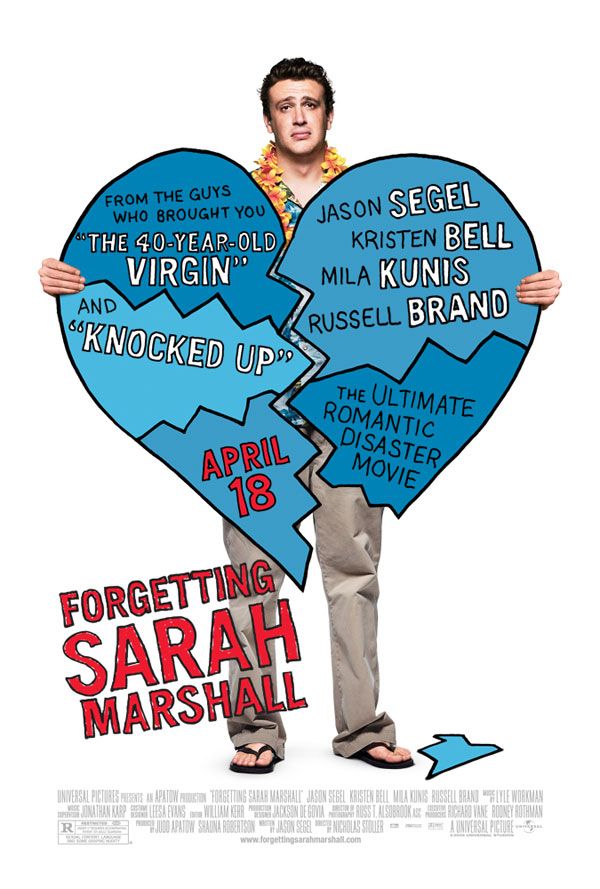
Movie Review: Forgetting Sarah Marshall

Directed by Nicholas Stoller
Starring Jason Segel, Kristen Bell, Mila Kunis, Russell Brand

2008

Plots for romantic comedies are never especially original and since Forgetting Sarah Marshall so helpfully provides the gist of the movie right in the title, I'll keep the synopsis portion of this review brief: television score composer Peter Bretter goes on a Hawaiian vacation to forget his actress ex-girlfriend only to discover that she is staying at the same resort with her new rock star boyfriend. Awkward antics ensue.

Written by and starring long-time Apatow regular Jason Segel, Forgetting Sarah Marshall inevitably must be compared to the recent slew of Judd Apatow produced movies that have flooded the market. For better or for worse all of those films have adhered to the same There's Something About Mary model of infusing third rate romantic comedy plotlines with elevated levels of profanity and risque humor and then casting overweight or unattractive male comedians opposite B-list starlets to draw in male and female fans alike. Though undeniably financially successful - somewhere studio execs are still in disbelief over just how many 18-24 year old males they tricked into buying tickets for 9 Months II - this model has yielded films that lack comedic consistency and that usually fall short even of the modest story standards set by the unapologetically trite and predictable romantic comedy genre. I recently read an article on The Asylum, the company that produces straight to DVD mockbusters like Transmorphers and Snakes on a Train, and found an uncanny parallel between their business model and Apatow's. When their Japanese buyers requested a submarine movie - a genre their monster craving US buyers had no interest in - Asylum responded by inserting a giant squid and calling it 30,000 Leagues Under the Sea. As Asylum exec David Latt noted, "the big submarine battles made the Japanese happy, the giant squid satisfied our domestic buyers, and we got to make a really fun movie."

Like Asylum, Apatow draws on a small pool of writers, directors, and actors to work on his films and everyone involved seems to be having an excellent time (check funnyordie.com or the DVD extras of any of these films for further proof of the non-stop behind the scenes fun). Although some of Apatow's early players have graduated on to careers of varying levels of success (Linda Cardellini for example has done some quality dramatic work under the radar) most alums have had their greatest success working within the safe confines of the Apatow world (see Seth Rogen and the otherwise unemployed Martin Starr). Jason Segel has been working with Apatow since the Freaks & Geeks days and although he has enjoyed some success outside of the Apatow world on the sitcom How I Met Your Mother, major film roles have not been forthcoming and it comes as no surprise that Segel returns to the fold for his first starring feature.

Although Forgetting Sarah Marshall has the requisite raunchy humor of its predecessors, it is far less concerned with hiding its romantic comedy roots and as such avoids the filmic identity crisis that crippled Knocked Up. Segel throws in plenty of frontal male nudity and similar low brow sight gags at us early on but the film quickly settles into a comfortable and predictable girl leaves boy, boy meets new girl who helps him rediscover his passion for life love story. Segel has been playing variations on the same well-intentioned, romantic screw-up since his days as Nick on Freaks & Geeks and, while he may not be proving himself to be especially versatile, there's no denying that he has the part down cold. As per usual with Apatow films, the best lines all go to male characters and the female parts are appallingly one-dimensional and underwritten. In past films, talented actresses like Catherine Keener and Leslie Mann have managed to coax substantial performances from woefully thin material but Kristen Bell and Mila Kunis lack their acting chops. They do as well as can be expected with what they're given to work with but both end up spending long stretches of the film with nothing to do but stand around looking pretty (ironically, one of the few scenes that allows them to show some personality actually involves them mutually complimenting one another on being pretty). Despite these shortcomings there are some bright spots in the movie. There is genuine chemistry between Segel and Bell and newcomer Russell Brand as Sarah's new rock star beau steals every scene he's in; unfortunately, pointless, momentum killing cameos from Apatow regulars take precedence over fleshing out these more interesting main characters.

Chances are you've already made your mind up about the Apatow family of films and if you loved Knocked Up and Superbad you'll probably find this entry lacking; however, if you found Knocked Up derivative and Superbad insufferable, you might find this one surprisingly watchable. Forgetting Sarah Marshall is a much more modest film and as such a more successful one; it makes a play for fans across genres, but for the most part Segel sticks to his strengths and the result is an unremarkable yet respectable romantic comedy for young adults.

Final verdict: No matter what side of the fence you're on in regards to Apatow films, Forgetting Sarah Marshall is lightweight, unoffensive fare worth a matinee-priced ticket or rental.

Product Review: Kashi TLC - Natural Ranch Tasty Little Crackers


For those who know me, this will come as no surprise: I do not like foods with strong tastes. For me, usually, the blander, the better.

With that said, I would like to offer a review of Kashi Natural Ranch TLC all natural snack crackers. Kashi has wittily used the acronym TLC to refer to “tasty little crackers.” After tasting these crackers, I have to ask, who wouldn’t want to give themselves a little TLC with these TLCs?

Aesthetically, they leave something to be desired; they look like a snack you may give a small rodent or bird. And, the consistency is what you’d expect from a cracker made from 7 whole grains, and no hydrogenated oils or trans fats – crispy and grainy. Don’t be surprised if you get a seed stuck in your teeth. However, the taste is absolutely heavenly: Earthy, hearty, with the slightest hint of ranch. After you take a sip of water, the taste is essentially completely cleared from your pallet, unlike many other ranch flavored snacks that seem to linger for hours on the back of your tongue.

While not particularly high in fiber (8% of your daily suggested value per serving), the sodium content is extremely low for a salty snack at 200mg. And as we all know, foods sans trans fats and high in whole grains are heart-healthy!

I bought these crackers at a small, over-priced campus grocer for $3.49, but I’m sure in a more traditional grocery store, they’d be much cheaper. If you can’t find them with the other snack crackers, try the health food aisle.

Sunday, April 27, 2008

DVD Review: Starting Out in the Evening

Directed by Andrew Wagner
Starring Frank Langella, Lauren Ambrose, Lili Taylor

2007

Seized with nostalgia for my days as an English Lit major, I put Starting Out in the Evening on my Netflix list last week. Frank Langella (Superman Returns, The Ninth Gate) plays Leonard Schiller, an octogenarian novelist struggling to finish his latest book when a beautiful grad student (Lauren Ambrose of bit parts on random tv shows fame) suddenly appears to interview him for her thesis/revive his career. Unfortunately, the film had a completely different effect than I had hoped for; rather than making me yearn for those days when I thought a career in literature would be a Utopian existence, I came away convinced that everyone associated with academia is a complete fuck.

Starting Out in the Evening creates a world where having four out of print novels and a modest teaching career is enough to finance a lifetime in a swank Manhattan apartment building with a doorman and a marble foyer. Being a cranky old author also gives you license to have weird, grandfatherly sex with any grad student whose life was changed when she read your book (bonus points if that grad student only wears designer evening wear). Also, in case you were worried about your legacy, everyone remotely associated with you (like your daughter's on again off again boyfriend) will periodically reread your books and remind you how much they respect and admire you. Despite not publishing in decades, you also still get invited to numerous literary events and parties where you can schmooze with other intellectuals, show off your new arm candy, and compare the contents of their floor to ceiling bookcases with your own. Authors can even have major strokes with no lingering side effects except needing to nap more frequently and when your grad student mistress finishes her thesis you'll still be fit enough to tell her off and give her a good slap for wasting your valuable time.

There's no denying Langella delivers a strong performance as Leonard Schiller but he's hardly a sympathetic character (although the frontal nudity was a bold play for vulnerability points) and Lauren Ambrose's tenacious student is scarcely more likeable. Whether she's pressing Schiller to admit the influence of D.H. Lawrence in his work or accusing a hip East Village journalist of going soft on Lou Reed, she comes across as completely insufferable. Their on screen chemistry is almost non-existent and by the end of the film I was bored to indifference, hardly caring that she learns a valuable lesson about life (what I'm not exactly sure) and that he discovers it's never too late to start over again. Unless you have a soft spot for passionless spring/winter romances, you can probably skip this one.

Book Review: The Old Religion by David Mamet


David Mamet is a critically acclaimed novelist, playwright and screenwriter. He is best known for his works like "Glengarry Glen Ross" for which he won a Pulitzer Prize and "American Buffalo". "The Old Religion" is the tale of Leo Frank, a Jewish factory owner who is falsely accused of the rape and murder of a young girl who happened to work at his factory. The book holds nothing back, the events are fully disclosed together with the testimony against Frank--including the one by the man who actually murdered the girl and several of his untrusting, anti-Semitic coworkers. "The Old Religion" takes a look into the psyche of a powerful Jewish man living in the South. It's a story of a man who will do and say anything to try and hide or blanket his Judaism in a world where he is seen as nothing but someone who just doesn't belong. Mamet creates an utterly original novel by showing a man who tries everything to be just an American--but instead his religion is constantly at the forefront. In addition, Frank is imprisoned but later abducted by an angry mob and lynched. Pictures of his corpse were later photographed and sold as postcards across the south for many years. "The Old Religion" seems provcative at it's core but it is really a statement on the still lingering hatred of the unknown in which we call "Minorities" in America.

Friday, April 25, 2008

DVD Review: Inside (A L'Interieur)

Directed by Julien Maury & Alexandre Bustillo
Starring - Alysson Paradis, Beatrice Dalle.
France, 2007

Lately I had been in the mood for a hard-hitting horror film and when I read about last week's US DVD release of Inside (A L'Interieur) I thought I had found exactly what I was looking for. Touted all over the internet as an impressive addition to the resurgent French Horror genre, Inside is the story of Sarah (Alysson Paradis), a pregnant young widow besieged by a crazed intruder (Beatrice Dalle) intent on forcibly removing her unborn child on Christmas Eve.

There is no shortage of brutal and exploitive horror films as directors now go for broke in an attempt to shock and frighten jaded genre aficionados, and though all the reviews I read warned of Inside's potent violence I was unprepared for just how far directors Julien Maury and Alexandre Bustillo were willing to go. To call their movie scary is to damn it with faint praise; Maury and Bustillo are adept at composing sickeningly elegant shots - both visually and aurally - and their violence is a step above their peers in artistry and realism. They almost completely avoid the campy scares and/or redemptive moralizing found throughout the genre and despite the lack of context offered by the film it avoids being violent just for violence's sake. Lest the audience forget just how vulnerable she is, shot after shot focuses on Sarah's pregnant stomach and Inside becomes an incredibly anxious film about obsession and fear. Even Sarah's relentless tormentor is not above succumbing to the tension, screaming in animalistic frustration when her goal eludes her. Both women are so emotionally invested in the fate of Sarah's baby that it becomes impossible to watch the film with any kind of detachment and each successive minute reveals more cringe-inducing brutality and heart-pounding tension than the last; mercifully the film is only 80 minutes long.

I find it difficult to criticize a film that so ably accomplishes its goals but I also hesitate to recommend this to anyone who doesn't know exactly what they're getting into. If you're looking for a good scare, chances are this is far too graphic and intense and if pure gore and thrills are what you're after, Inside is likely too emotionally and psychologically demanding. Unless you're looking to spend an hour and a half with your heart racing in terror and disgust, there is little satisfaction to be found in Inside and you will be glad when it's over.

Tuesday, April 22, 2008

DVD Review: Before the Devil Knows You're Dead

Directed by Sidney Lumet
2007
Starring: Philip Seymour Hoffman, Ethan Hawke, Marisa Tomei, Albert Finney, Rosemary Harris


Before the Devil Knows You’re Dead opens with a jewel heist that leaves an old woman and the burglar both dead. The narrative immediately flashes back to three days before the crime and the film seems destined to become a clever yet predictable modern heist flick. However, the script by playwright Kelly Masterson aspires to much more than criminal intrigue and in the hands of director Sidney Lumet (Dog Day Afternoon, 12 Angry Men) it becomes a tragedy of epic proportion.

Brothers Hank (Hawke) and Andy Hanson (Hoffman) are both financially overextended – hot shot real-estate broker Andy has been stealing from his firm to pay for a secret drug habit and sweet, hapless Hank is three months behind in child support and tuition for his daughter’s fancy private school. Flashbacks reveal that they have plotted to rob their own parents’ jewelry store; they know the layout, the security, the employees, and their consciences can rest easy knowing that anything they steal is fully insured. Unfortunately for Hank and Andy, it becomes painfully obvious how this seemingly perfect crime went horribly wrong as the flashbacks reveal their miscommunication and criminal ineptitude.

In the hands of some directors non-linear narration is like a magic trick, misdirecting the audience’s attention and building expectation before unveiling a final, stunning twist that leaves you wondering how you possibly could have seen it coming. Lumet, however, seems completely uninterested in fooling his audience; he grimly lays out all his cards in the first third of the film and proceeds to patiently explain exactly how this particular trick has gone wrong. His characters seem to think they are operating in shadows and darkness but the film is sun drenched and overexposed; even when they’re inside, bright light pours in through every window and emanates from the harsh fluorescents of ceiling fixtures and appliances. Beneath this revealing glare we know all the characters’ secrets long before they do and there is a morbid fascination in watching them scheme and lie to avoid what we know is inevitable.

It is a pleasure to see Lumet deliver a film this ambitious and aggressive so late in his career and all of his actors rise to the occasion to give inspired performances. Philip Seymour Hoffman (Capote, Boogie Nights) smothers Andy’s barely concealed desperation in sleazy nonchalance; he brags that he knows all the angles and watching his cocky façade crumble is a treat. Ethan Hawke (Training Day), typically reliable yet unspectacular, gives a fine performance as younger brother Hank, spending most of the film looking like he’s about to throw up. His ex-wife (Amy Ryan, Gone Baby Gone) – and his daughter – routinely remind him that he’s a loser and it’s a shock that he musters up the backbone to have an affair with Andy’s wife, played by Marisa Tomei (In the Bedroom) in a small but sexually and emotionally charged role. The film’s best performance comes from Albert Finney (Big Fish, Miller's Crossing) as the Hanson family patriarch. Blindsided by the murder that opens the film, he takes it upon himself to investigate and much of the film’s suspense is derived from watching his joviality transform into mournful vengeance.

Before the Devil Knows You’re Dead stands as one of the finer films released in recent memory. Curiously ignored around awards time (even given the number of excellent films last year), it deserves a second look on DVD and will likely stand as an impressive addition to Lumet’s already illustrious filmography.

Saturday, April 19, 2008

Book Review: Of Walking in Ice

Munich - Paris
23 November - 14 December 1974
by Werner Herzog

"My boots were so solid and new that I had confidence in them. I set off on the most direct route to Paris, in full faith, believing that she would stay alive if I came on foot. Besides, I wanted to be alone with myself."

Upon learning that his friend Lotte Eisner was dying, Werner Herzog packed a small duffel with the essentials (compass, notebook, jacket) and set off alone on foot across half of Europe to save her. He walked for three weeks, sleeping at night in barns and deserted summer cottages and chronicling the details of the trek (both beautiful and ugly) in his journal. In an early entry he notes he would have made the trip in about an hour and a half by plane but anyone familiar with Herzog's work will find his preferred mode of transport unsurprising.

"Only if this were a film would I consider it real."

Like his films, Herzog’s journal remains firmly in the moment. His nightly entries capture the changing momentum and feel of his days as the weather and physical demands of the trip alternately frustrate and exhilarate him. Although he allows himself the occasional rant, for the most part he eschews personal introspection and epiphany hunting in favor of an avid interest in everything around him. Equal weight is given to the solving of an unfinished crossword puzzle in a home he has broken into as he devotes to choosing his route. His egalitarian perspective on the import of events creates momentum and makes for an exciting reading experience (aside from a break to grab a beer and some pretzels, I found myself compelled to finish this in one sitting).

"At the market was a boy on crutches, leaning against the wall of a house as my feet refused to cooperate anymore. With a single, brief exchange of glances we measured the degree of our relationship."

Stylistically, Herzog's prose borrows from both his feature and documentary film making styles, combining poetic austerity with more blatant philosophizing. In his films he is adept at exposing the beauty in found moments (Kinski and the butterfly in My Best Fiend, the opening of Aguirre, etc...) but in his documentary narration he is prone to pushing for a meaning beyond what seems to be inherent (for example his comments on the bear that killed Treadwell in Grizzly Man). There are plenty of musings of the latter type in his journal but he also seems to intuit which moments are best left with a minimum of superfluous description. I came away impressed with the quality and momentum of Herzog’s writing and although familiarity with his films certainly enhances appreciation it’s hardly a prerequisite to enjoying this wonderful little book.

Sunday, April 13, 2008

DVD Review: Fists in the Pocket

Directed by Marco Bellochio
1965

Italy


Fists in the Pocket
focuses on Alessandro, a death-obsessed epileptic living with his misfit family in a secluded Italian villa. He passes the time reading fake newspaper headlines to his blind mother, neglecting his retarded brother Leone, and making incestuous advances towards his sister Giulia while normal elder brother Augusto acts as reluctant caretaker to the entire family. Augusto has aspirations to one day marry his pretty girlfriend and move to town but as long as he is responsible for his dependent family this is impossible. Alessandro (who bears a disturbing resemblance to Marlon Brando crossed with Doogie Howser) plots to hasten his brother’s middle class escape by offing their helpless family members one by one.

In an early scene, Augusto chides his younger brother for having no ambition or drive, and the murders reflect his criticism. There is no spite or perverse satisfaction in Alessandro’s murders, no terror or suspense in his scheme; he very literally takes his victims by the hand and leads them to their deaths, dispatching of them with as little effort as possible. By the time he actually kills his first victim his intentions are so obvious that there is little to be surprised by. The murders become incidental to our understanding of Alessandro and a scene where he attends a dance with Augusto is far more revealing of his character than watching him lead his blind mother off a cliff.

Reviews for Fists in the Pocket invariably describe it as a “rethinking of the horror genre’ and in the broadest sense this is an apt description; the classic elements of a horror film are all there – murder in an isolated setting, helpless victims, and a killer whose twisted physical aberrations match his internal deformities. However, the film emerges not so much as a horror film but as a film about horrific things. First time director Marco Bellochio had worked with Pasolini early in his career, and visually and thematically Fists in the Pocket has more in common with traditional ‘60s European art house cinema than its Italian horror contemporaries.

If this film is indeed a “rethinking of the horror genre,” then Bellochio has rethought it right out of the genre and almost into the realm of social drama. Unfortunately for Bellochio, there are far better films to choose from in either genre and while this hybrid is certainly stylistically interesting, it falls short of its contemporaries. Horror fans seeking an elegant and stylish B&W horror film would be better served seeking out Franju’s Eyes Without a Face (1960) and if artful examinations of dispassion and social morality are your cup of tea, then there are any number of bold and audacious films that merit a viewing sooner than this one.